SnakeOil Synth
Chasing a sound I had heard about for years, then building the synth that makes it.
The sound
I first saw it in a YouTube video of a synthesizer with a Moog-style 24 dB ladder filter, also called a four-pole filter. Turn the resonance all the way up and the filter whistles. I love the sound of the old synthesizers, so I tried to make that whistle with synth plugins in Reaper and Sonar. None of them would do it, and eventually I gave up.
Then I found the Behringer Deepmind 12. Its Moog-style 24 dB ladder filter can self-oscillate and produce a sine wave. I bought it almost immediately and started experimenting.
A prototype in Python
When AI coding assistants arrived, I decided to try building my own software synth. I started in Python because it already had good audio libraries. I got a prototype that could play simple note sequences from a file, and then let it sit for about a year.
Handing it to Jilly
Recently my good friend Shannon Duncan, founder of Hackers in the Loop, introduced me to Jilly: a free Discord bot, powered by DeepSeek, that can read, write, and edit code. I gave the project to Jilly, and it produced the first working version. It was rough, lacked features, and used a lot of CPU, but it worked.
I took it home and let Claude Sonnet 5.5 have a go while I tested and we worked out bugs. We switched some libraries, adding SciPy among others, and ended up with a 12-voice polyphonic synthesizer with two oscillators. One has a sawtooth and a square wave. The other is a square wave that the first can modulate.
From there I added feature after feature, throwing in as many ideas as I could, then testing and fixing until I was happy with what it did. It has a resonant filter, envelopes, LFOs, a modulation matrix, unison, and an effects chain.
Past the limits of Python
Even with SciPy, Python limited the filter. It still could not oscillate at maximum resonance, which was the whole point. So I sent the code back to Jilly and asked it to port the Python application to a VST3 plugin in C++ with JUCE. Jilly did an amazing job on the conversion. I gave the result back to Claude to iron out a couple of bugs, and that produced the plugin as it stands today.
Where it stands
In the C++ plugin, the filter self-oscillates at maximum resonance, which is the sound I set out to make. As far as I can tell, it is the first free synth plugin of its kind that does that.
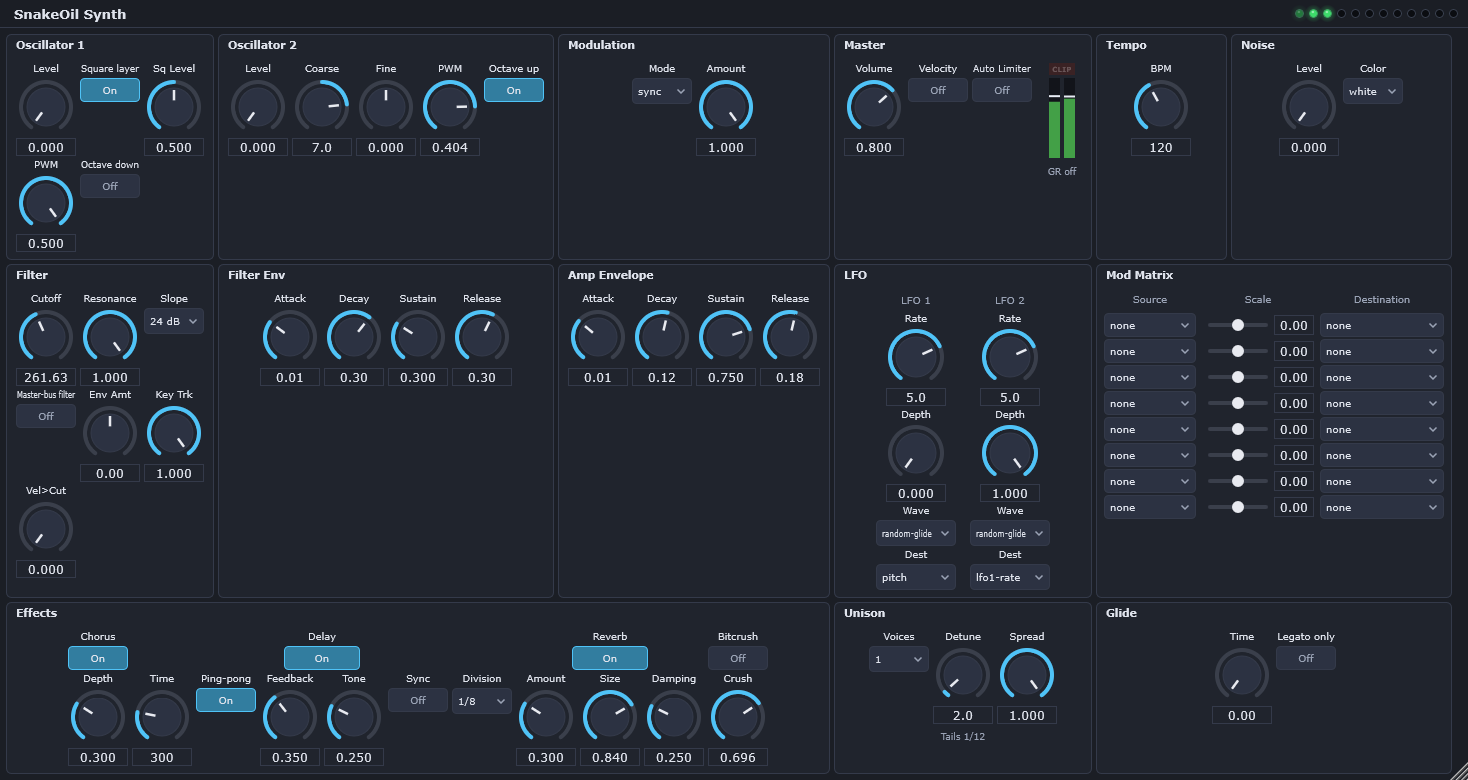 SnakeOil Synth whistling. Both oscillator levels and the noise level are at zero, the mod matrix is empty, resonance is at 1.000 on the 24 dB slope, and the master meter still shows output: the filter is oscillating on its own. Click the image to see it full size.
The plugin builds on Windows, because that is what I use. It is licensed under AGPL-3.0, and anyone can build it from the source on my GitHub. I will upload a 1.0 release when I am satisfied with the plugin and how it functions. The Python version is still in the same repository as the reference the plugin was checked against.
SnakeOil2
I’m already working on a second version. SnakeOil2 has twin dual-oscillator banks: every voice plays two complete oscillator setups at once, each with its own modulation, noise, filter, and envelopes, for a more layered sound. It is a Python prototype of a future VST3, it lives in its own repository, and it reuses a lot of code from the first SnakeOil Synth.
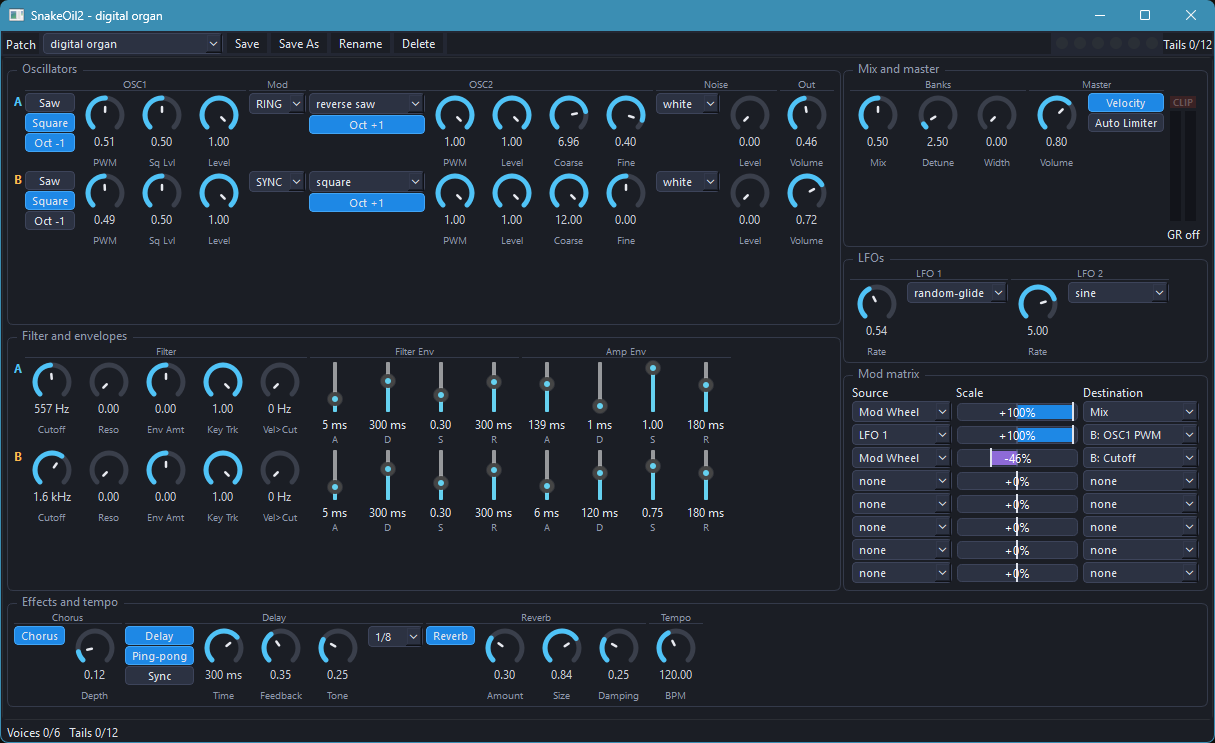 A development build of SnakeOil2 running a patch called “digital organ”. Banks A and B each have their own oscillators, modulation, noise, filter, and envelopes, and the Mix, Detune, and Width controls blend them. Click the image to see it full size.
Next: ComfyUI nodes →