SantOS
A learning project that grew into an operating system with its own kernel.
I had studied x86 assembly and still had no idea how an operating system actually worked. I knew the theory: a bootloader loads the operating system, and bootloaders are usually hard-coded to one OS. What I could not explain was how the machine gets from that first sector to running the OS’s own code. SantOS is how I found out.
Starting out with an AI assistant
I started in Windsurf and asked its Cascade assistant to find resources on the problem. I copied some code and started debugging, leaning on the assistant to look things up while I worked. As the project grew I learned to drive a floppy disk controller through IRQs and to convert LBA addresses to CHS. Then I learned how a two-stage bootloader gets the machine into 64-bit mode, and from there it was a lot of work on the second stage, using boilerplate from several sources. I spent weeks debugging memory until the compiled kernel finally loaded and ran.
Moving to C
Once I left assembly and worked in C, which I know much better, things went faster. I read up on memory and disk management and kept building. Today SantOS has:
- a three-stage bootloader that enters 64-bit long mode, with FAT12 fully working
- a 64-bit kernel with a physical memory manager, paging, and a heap
- drivers for the VGA text screen, PS/2 keyboard, PIT timer, and the floppy controller with DMA
- a system call interface on
INT 0x80 - a loader for 64-bit ELF programs stored on the FAT12 disk
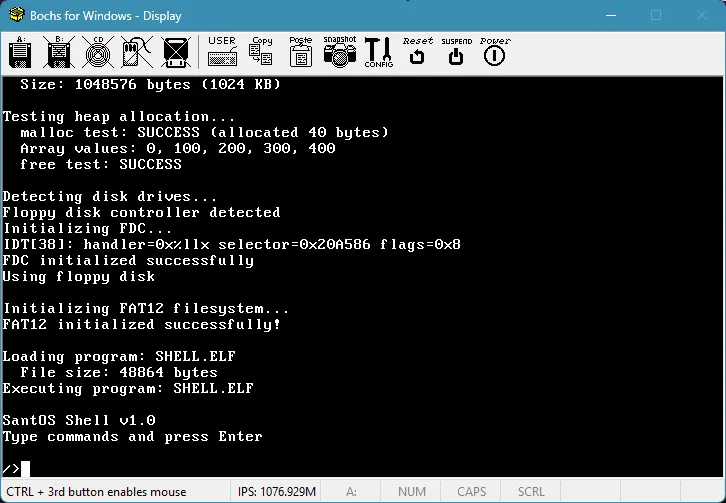 SantOS booting in Bochs. The kernel passes its heap test, initializes the floppy controller and FAT12, loads the shell from disk, and drops to a prompt.
Userspace
To have something to run on the kernel, I put programs on the disk image: a shell with piping, history, and scripts, a text editor called SEdit, and a small demo program. The AI wrote many of those programs so that I had something to test the kernel with. I spent a good deal of time tweaking SEdit because of that. I also started a prototype assembler, sasm, that turns x86 assembly into a program. I have not tested it in a while, so treat it as experimental.
Where it stands
FAT16 and FAT32 support are still unfinished. I’m happy with where it is. I learned a lot, dusted off old skills, and did what I set out to do: build a bootable kernel.
This project is and ever only was a learning project. If you have contributions you would like to make, please feel free to make them. Just be prepared for me to ask a LOT of questions.
Next: Vintage Story mods →